The broad field of soft matter physics includes the study of complex fluids, such as colloids, liquid crystals, polymers, gels, active matter, and other similar systems, which are easily deformed by external forces. Soft matter typically exhibits interesting phenomena at the mesoscopic scale, making it particularly well-suited for investigations with Aresis optical tweezers, as they provide simultaneous control over hundreds of individual traps with nanometre precision and the ability to measure forces in the piconewton range.
Common applications of the tweezers in soft matter research include measuring forces between droplets or colloidal particles, assembling larger numbers of individual particles into predetermined complex structures, precisely melting liquid crystal, and studying collective phenomena like aggregation, self-assembly, and colloidal statistical mechanics. With an open hardware and software architecture, Aresis optical tweezers offer great flexibility and customisation of the experiments. The intuitive user-friendly interface, automatic calibration, and a high degree of automation further simplify the measurements.
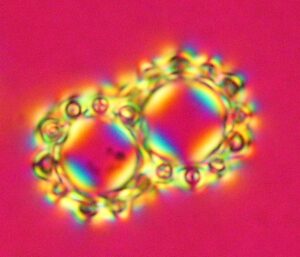
Aresis optical tweezers are widely used in soft matter research, as demonstrated by following examples.
Example 1: Measuring interparticle forces in water-in-oil emulsions
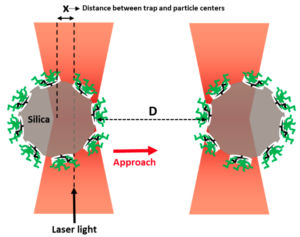
Efficient separation of water-in-oil emulsions is essential for successful oil production and transportation. Using Aresis optical tweezers, researchers have investigated the efficiency of ultrasound waves in breaking down asphaltene-stabilised water-in-oil emulsions. The study showed that ultrasound disrupts the stabiliser, facilitating the emulsion separation. Force-distance measurements helped to identify chemical compounds that increase the attractive forces between individual oil droplets, promoting coalescence and accelerating the emulsion separation process.
Selected related references:
Optical Tweezers-Based Measurements of Colloidal Forces between Asphaltene Thin Films: Effect of Ultrasonication; R. Khalesi Moghaddam et al 2023 Langmuir 39 17009; DOI: 10.1021/acs.langmuir.3c01183 LINK
Synthesis of a novel reverse demulsifier with the characteristics of polyacrylate and polycation and its demulsification performance; Y. Wang et al 2021 J Appl Polym Sci 138: e51200; DOI: 10.1002/app.51200 LINK
The attraction between like-charged oil-in-water emulsion droplets induced by ionic micelles; S. Liu et al 2022 Coll Surf A 654, 130143; DOI: 10.1016/j.colsurfa.2022.130143 LINK
Interface behaviors of two heavy oil activators and their influences on the treatment of oilfield produced fluid; X. Wang et al 2022 Sep Sci Tech 57, 3012-3022; DOI: 10.1080/01496395.2022.2088390 LINK
Example 2: Interparticle Forces in Nematic Liquid Crystals
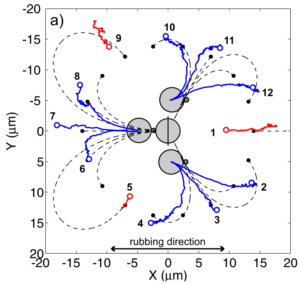
Microparticles, when immersed in a nematic liquid crystal, distort the liquid crystalline orientational ordering. When the distortions of two particles overlap, the particles experience strong anisotropic elastic forces. By tracking the trajectories of particles in these distorted nematic fields, the interaction potential for both dipolar and quadrupolar forces was extracted. It was found that such complex interactions result in the formation of various nematic colloidal crystals. Aresis tweezers were used also to determine the drag coefficient acting on a moving sphere and inter-particle forces between microrods.
Selected related references:
2D Interactions and Binary Crystals of Dipolar and Quadrupolar Nematic Colloids; U. Ognysta et al 2008 Phys Rev Lett 100, 217803; DOI: 10.1103/PhysRevLett.100.217803 LINK
Interparticle Potential and Drag Coefficient in Nematic Colloids; J. Kotar et al 2006 Phys Rev Lett 96, 207801; DOI: 10.1103/PhysRevLett.96.207801 LINK
Laser Trapping of Small Colloidal Particles in a Nematic Liquid Crystal: Clouds and Ghosts; I. Muševič et al 2004 Phys Rev Lett 93, 187801; DOI: 10.1103/PhysRevLett.93.187801 LINK
Interactions of micro-rods in a thin layer of a nematic liquid crystal; U. Tkalec et al 2008 Soft Matter 4, 2402-2409; DOI: 10.1039/B807979J LINK
Measuring Electric-Field-Induced Dipole Moments of Metal-Dielectric Janus Particles in a Nematic Liquid Crystal; D. Kumar Sahu et al 2020 Phys Rev Appl 14, 034004; DOI: 10.1103/PhysRevApplied.14.034004 LINK
Example 3: Assembly of complex colloidal structures
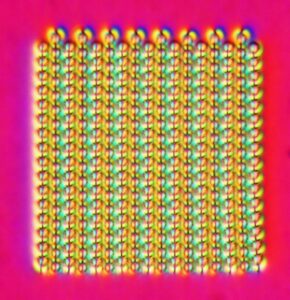
Optical tweezers were used to assemble 2D colloidal crystal structures in a nematic liquid crystal. It was found that the structures are stabilised by topological defects and different structures were observed depending on the defect symmetry around the microparticle. The resulting structures are electrically tunable, making them suitable for use as diffraction gratings in photonics.
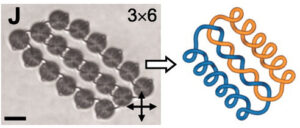
In chiral nematic colloids, even more intricate patterns were achieved, as laser tweezers enabled creation of knots and links with arbitrary complexity. The researchers successfully produced all knots and links with up to six crossings, including the Hopf link, the Star of David, and the Borromean rings, demonstrating a highly unusual and fascinating soft matter state.
Selected related references:
Two-Dimensional Nematic Colloidal Crystals Self-Assembled by Topological Defects; I. Muševič et al 2006 Science 313 954; DOI: 10.1126/science.1129660 LINK
Reconfigurable Knots and Links in Chiral Nematic Colloids; U. Tkalec et al 2011 Science 333 62; DOI: 10.1126/science.1205705 LINK
Design of 2D Binary Colloidal Crystals in a Nematic Liquid Crystal; U. Ognysta et al 2009 Langmuir 25, 12092; DOI: 10.1021/la901719t LINK
Hierarchical self-assembly of nematic colloidal superstructures; M. Škarabot et al 2008 Phys Rev E 77, 061706; DOI: 10.1103/PhysRevE.77.061706 LINK
Example 4: Hydrodynamic phenomena and motility
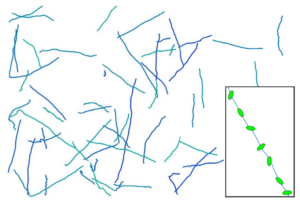
The motility of flagellated bacteria E. coli was studied in dilute colloidal suspensions, revealing behaviour similar to that detected in polymer solutions. An enhancement in motility of up to 80% was observed, accompanied by a significant reduction in bacterial wobbling. Other experiments in this area include optomechanical transport and particle sorting, transport phenomena in dynamic porous materials, fluid flow generation by artificial cilia, and the behaviour of passive particles in active baths.
Selected related references:
The colloidal nature of complex fluids enhances bacterial motility; S. Kamdar et al 2022 Nature 603 819; DOI: 10.1038/s41586-022-04509-3 LINK
Optomechanical Wagon-Wheel Effects for Bidirectional Sorting of Dielectric Nanoparticles; X. Xu et al 2021 Laser Photonics Rev. 15 2000546; DOI: 10.1002/lpor.202000546 LINK
Self-assembled artificial cilia; M. Vilfan et al 2010 Proc. Natl. Acad. Sci USA 107 1844; DOI: 10.1073/pnas.0906819106 LINK
Constraint Dependence of Active Depletion Forces on Passive Particles; P. Liu et al 2020 Phys Rev Lett 124, 158001; DOI: 10.1103/PhysRevLett.124.158001 LINK
Selected other publications related to soft matter research performed with Aresis solutions:
Electrically tunable liquid crystal optical microresonators; M. Humar et al 2009 Nature Photonics 3 595; DOI: 10.1038/NPHOTON.2009.170 LINK
Fabrication of microfluidic chips using laser click deposition; M. Lv et al 2022 Sens. Diagn. 1 803; DOI: 10.1039/d2sd00060a LINK
Color Tuning Using Scanning Optical Tweezers; B. Yao et al 2023 Adv. Photonics Res. 4, 2300205; DOI: 10.1002/adpr.202300205 LINK
Optically Controlled Living Micromotors for the Manipulation and Disruption of Biological Targets; H. Xin et al 2020 Nano Lett 20, 7177; DOI: 10.1021/acs.nanolett.0c02501 LINK
Measuring Single Bacterial Viability in Optical Traps with a Power Sweeping Technique; H. Li et al 2022 Anal Chem 94, 13921; DOI: 10.1021/acs.analchem.2c02942 LINK