In 1997, the Nobel Prize was awarded to Professor Steven Chu for his pioneering research on cooling and trapping atoms using laser light. Almost thirty years later, the field of cool atoms is again getting hot as advances in quantum research and technology require precise manipulation of individual atoms.
Aresis offers a fully integrated system for quantum optics research, featuring a stable laser (1064 nm, 5W CW), acousto-optic deflectors for precise beam steering, high-speed electronics, and customisable software. The complete unit, CALM 1064-A: Cold Atom Laser Manipulator, is designed to maximise user efficiency while maintaining the typical Aresis reliability and flexibility. A dedicated I/O unit enables precise hardware synchronisation of trap operation with timing accuracy better than 10 microseconds. The TCP interface provides full control over all optical trap parameters, allowing seamless integration into software running the experiment.
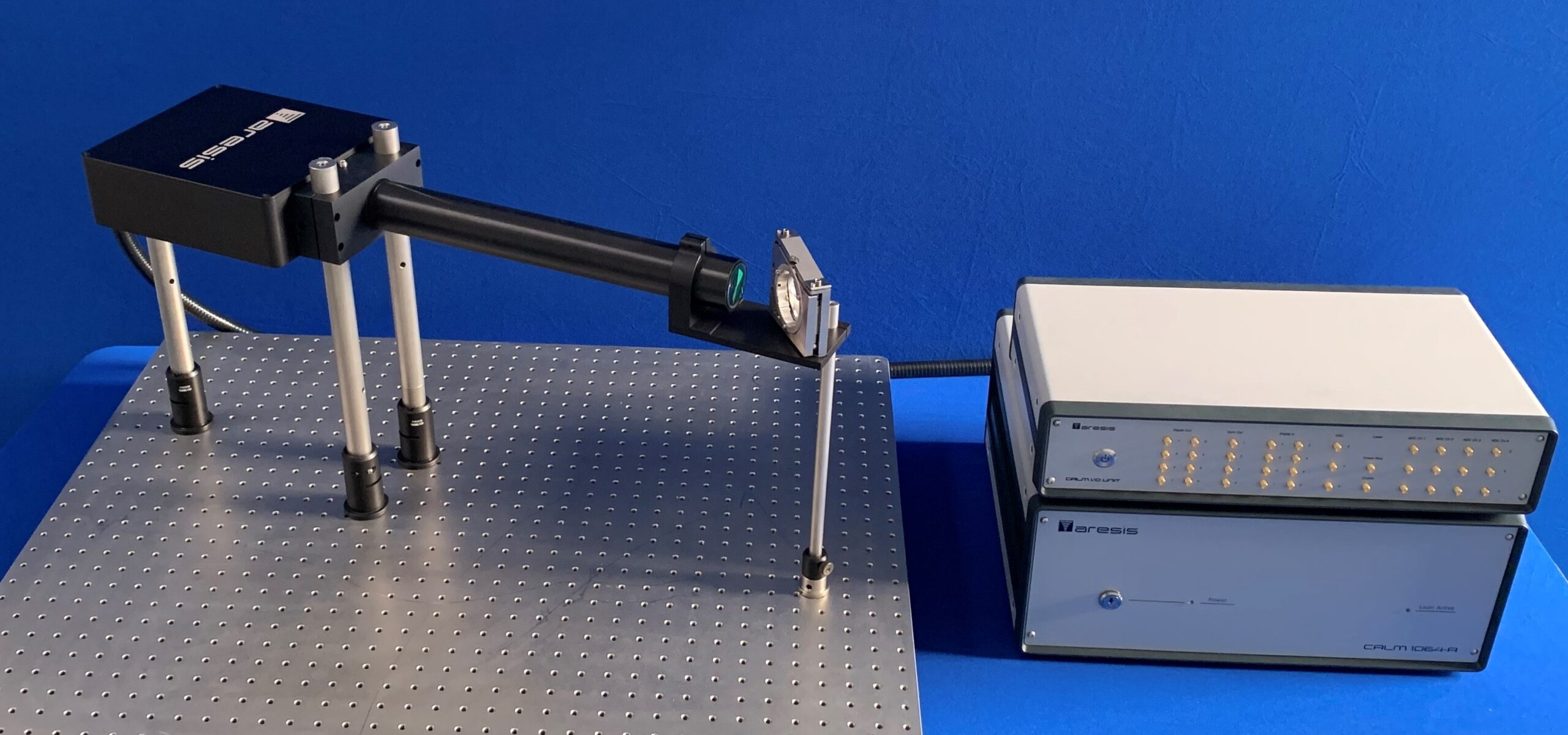
The Aresis CALM unit is a complete turnkey multi-trap system for quantum optics research, capable of simultaneously generating 2500 traps in either 1D or 2D arbitrary arrays, with sub-nanometer positioning resolution. The unit is easily integrated into existing or new experimental setups, and is fully compatible with standard optical equipment.
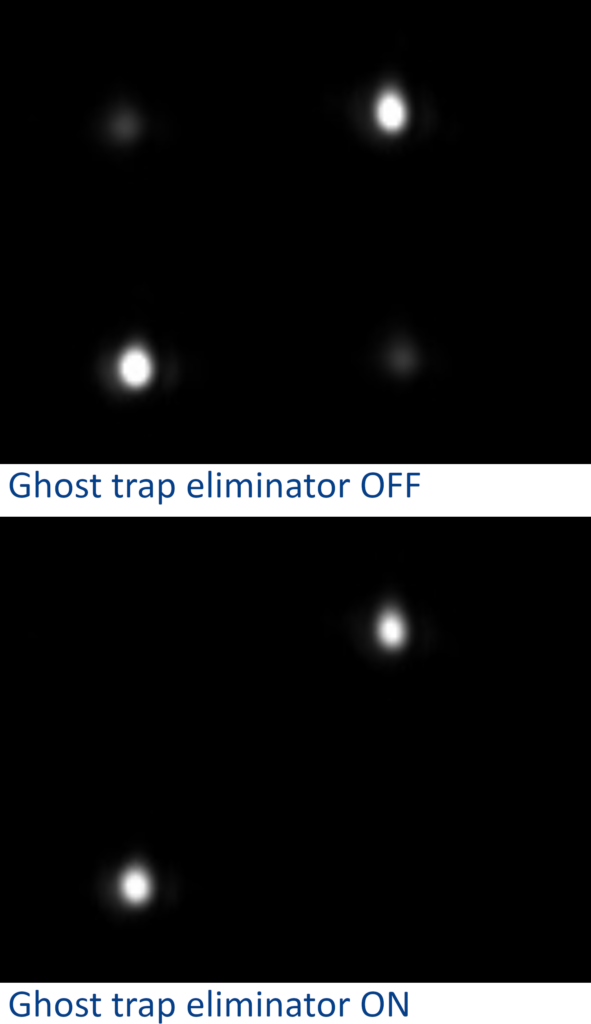
A key feature is that the optical unit is shipped permanently pre-aligned, eliminating the need for user realignment and ensuring minimal to no maintenance. A specialised algorithm has been developed to suppress ghost trap artifacts (see image), and automatic field flat compensation technology is used for linearising the AOD response. The system also features fully automatic calibration and a dedicated I/O unit for automatic synchronisation with the rest of the experimental setup, guaranteeing an excellent user experience.
The primary research applications of the Aresis CALM system include quantum simulation, quantum computing, fundamental quantum mechanics, quantum metrology, ultracold chemistry, and the study of Bose-Einstein condensates.
Aresis collaborates actively with the Cold Atoms Laboratory at the J. Stefan Institute (Slovenia), which already uses Aresis CALM unit in its academic research.
Example 1: Trapping clouds of cesium atoms
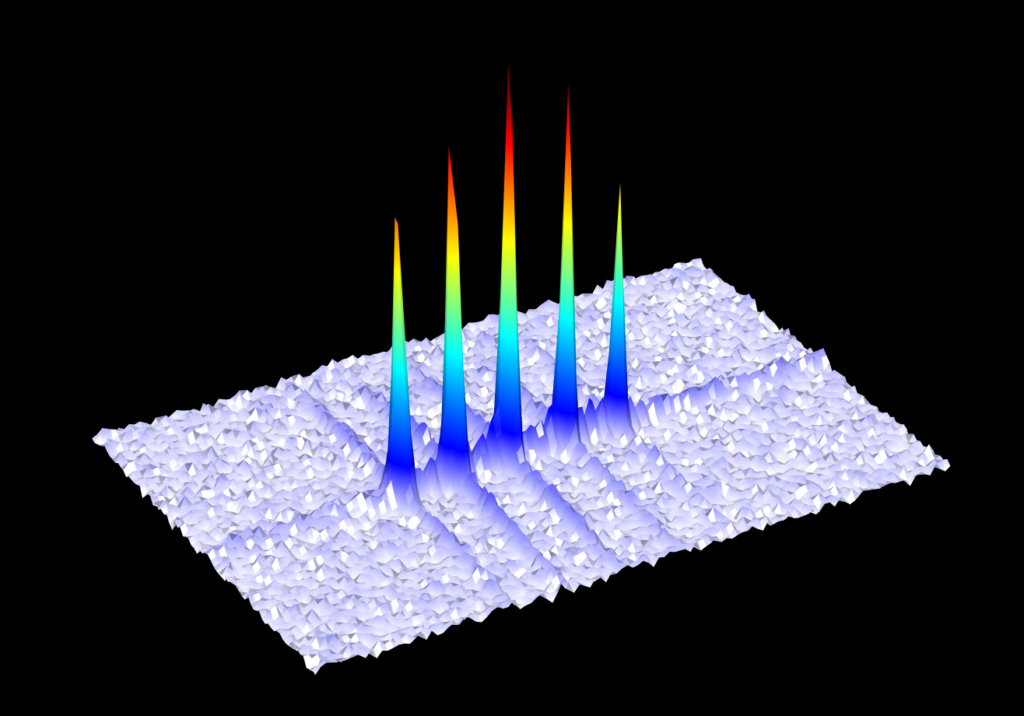
Aresis optical tweezers were used to trap cesium atoms at ultra-low temperatures as low as 50 nK. We demonstrated several successful methods for creating 1D arrays of atomic ensembles. One approach involves loading the optical traps directly from a large dipole trap while simultaneously performing evaporative cooling. Other techniques involve two-step processes: first, the atomic cloud undergoes evaporative cooling in a dimple trap, followed by its expansion and trapping with an array of optical tweezers. The Aresis setup also enables the creation of arbitrary time-averaged and dynamic potentials, such as box potentials, 1D harmonic potentials, and controlled splitting of atomic ensembles.

Selected related references:
Preparation of ultracold atomic-ensemble arrays using time-multiplexed optical tweezers; Katja Gosar et al 2022 Phys. Rev. A 106 022604; DOI: 10.1103/PhysRevA.106.022604 LINK